


Mansoura University Emergency Hospital Successfully Saves Patient with Penile Stab Wound Through Emergency Surgery
- Hits: 24
 Controlling the Bleeding in the Heart and Repairing Injuries to the Right Ventricular Outlet and Left Lung
President of Mansoura University: The Emergency Hospital Represents the First Line of Defense in Dealing with Critical Injuries and Continues to Perform its Mission Efficiently Around the Clock
In a race against time to save a patient with a penetrating heart wound, a multidisciplinary medical team at Mansoura University Emergency Hospital successfully performed emergency surgery, saving the life of a patient who arrived at the emergency department in extremely critical condition. The patient had suffered a penetrating stab wound to the heart, causing a sharp drop in blood pressure and sudden cardiac arrest during initial treatment. The medical team was able to control the bleeding and repair the injuries, stabilizing the patient's condition, and he continues to receive medical care.
Prof. Cherif Khater, President of Mansoura University, affirmed that the University Emergency Hospital is one of the most important specialized medical facilities for receiving emergency and critical injury cases in Dakahlia Governorate and neighboring governorates. It plays a pivotal role in saving patients' lives around the clock, thanks to the readiness of its medical staff and the availability of advanced diagnostic and treatment capabilities. He added that this success reflects the efficiency of the emergency system at university hospitals, its rapid response, and the integration of various medical specialties. He emphasized the university's commitment to continuously developing its hospitals and equipping them with the latest technologies and qualified personnel, contributing to the provision of advanced and safe medical services for citizens.
The university president commended the efforts of the university hospitals' administration, led by Prof. Ashraf Shoma, Dean of the Faculty of Medicine and Chairman of the Board of Directors of University Hospitals and Specialized Medical Centers, and Prof. El-Shaarawy Kamal, Executive Director of University Hospitals, in supporting the treatment system and providing the necessary resources to handle critical cases. He also praised the efforts of the emergency hospital administration, medical teams, nursing staff, and support personnel, who work collaboratively to ensure the swift rescue of patients and achieve the best possible treatment outcomes.
Upon the patient's arrival at the emergency department, the medical team handled the case according to emergency protocols. The patient was immediately assessed, the necessary medical support was provided, blood bags and required supplies were prepared, and relevant medical teams were summoned in record time due to the severity of the injury. The emergency medicine team, comprised of Dr. Mohamed Hossam El-Sayed, Assistant Lecturer of Emergency Medicine, Dr. Ahmed El-Darwany, Dr. Mohamed Emad El-Qatt, and Dr. Mohamed Ashraf El-Baz, all resident physicians in the department, initially managed the case. They successfully stabilized the patient and prepared him for urgent surgery.
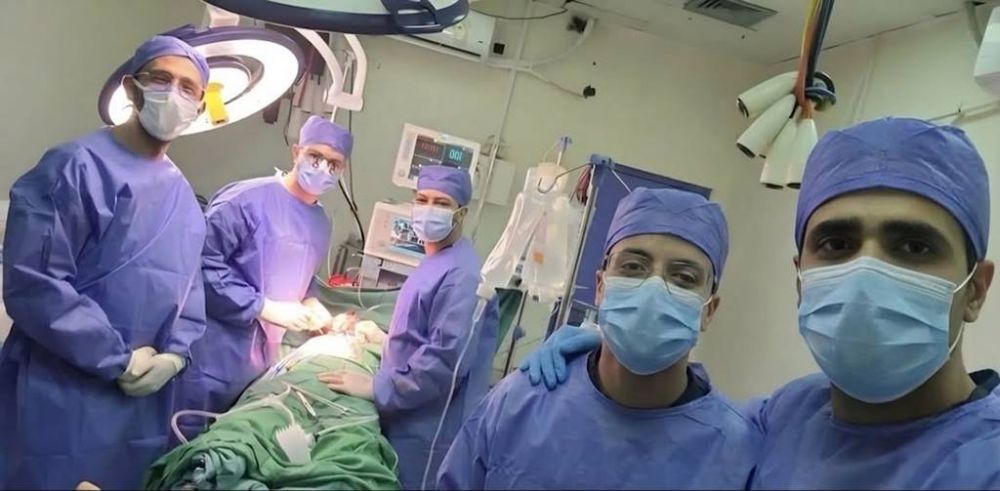
The patient was immediately transferred to the operating room, where the cardiothoracic surgery team, under the supervision of Dr. Mohamed Sand, Head of the Cardiothoracic Surgery Department, performed an emergency thoracotomy to control the cardiac hemorrhage. They successfully repaired the injury to the right ventricular outlet and the lower lobe of the left lung, with the participation of the cardiovascular, anesthesia, and intensive care teams.
The team also assisted in the surgical procedure. The surgical team included Dr. Mohamed Gabr, Lecturer of Cardiothoracic Surgery; Dr. Mohamed Nasser, Assistant Lecturer of Cardiothoracic Surgery; Dr. Hazem Fouda, Teaching Assistant of Cardiothoracic Surgery; Dr. Farouk Abbas; and Dr. Mohamed El-Nemer, both resident physicians in the department. Dr. Mostafa Moheb, a resident physician in the Cardiovascular Department, also participated. The anesthesia and intensive care team included Dr. Sayed Mohamed Sayed, Teaching Assistant in the department; Dr. Mohamed Walid Aboushahar; and Dr. Ahmed Shaaban, both resident physicians in the department.
Following the successful surgery, the patient was transferred to the intensive care unit in stable condition. He was weaned off the ventilator just four hours after the surgery, with his vital signs stabilizing and his health continuing to improve.
Dr. Amir Fikry, Director of the University Emergency Hospital, emphasized that this success reflects the hospital's readiness to handle even the most delicate injuries and critical cases around the clock. This is thanks to an integrated system that relies on rapid response, immediate coordination between different specialties, and the availability of qualified medical personnel and the necessary resources for immediate intervention. He added that the emergency hospital receives a large number of critical cases, road accident victims, and complex injuries daily, and is committed to providing the highest levels of medical care according to the latest treatment protocols. He praised the high level of professionalism and teamwork demonstrated by the medical team and nursing staff, which played a major role in saving the patient's life.
The nursing staff played a pivotal role in the successful management of the case, from receiving the patient and preparing them for surgery, through the operating and intensive care phases, to post-operative follow-up. The reception and recovery nursing team, operating room nurses, and surgical intensive care nurses all participated with high efficiency and rapid response, which had a significant impact on the success of the treatment plan. This was in addition to the efforts of the technicians and medical maintenance crews in ensuring the readiness of equipment and operating rooms throughout all stages of the case.
The nursing staff team included: Mohamed Atef and Mohamed Hamed, reception and recovery nursing specialists; Omar Al-Husseini Al-Shahawi and Israa Mohamed Nasr, surgical intensive care nursing specialists; and Ahmed Al-Amir, Mustafa Al-Bahrawi, Ahmed Kamal, Mohamed Al-Rifai, Islam Ramzi, Tariq Emad, Ziad Mohamed, Mahmoud Yasser, Khaled Emad, Khaled Mohammadi, and Mohamed Arafat, operating room nursing specialists.


